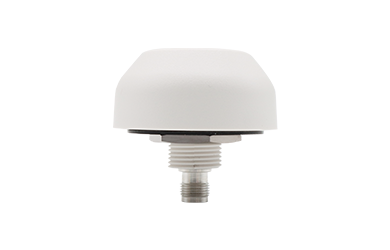
Reliable time synchronization begins before the GNSS receiver generates a 1PPS signal. The antenna, cable, connectors, mounting structure, and surrounding RF environment all affect the timing chain.
GNSS can provide timing at the nanosecond level, but this does not mean every GNSS clock will achieve the same result. One-way signal propagation alone introduces at least 3.3 microseconds of delay per kilometer, while multipath and hardware delays can also create errors.¹ The right antenna should therefore be selected as part of the complete RF system—not by looking at antenna gain alone.
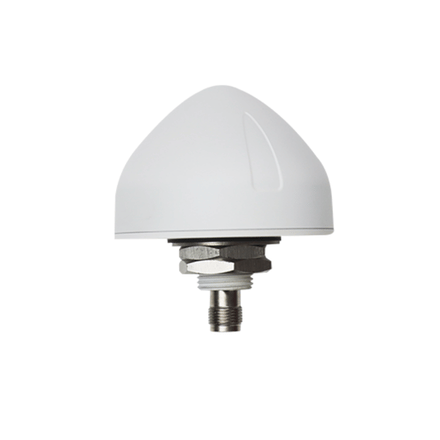
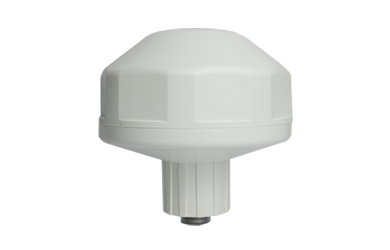
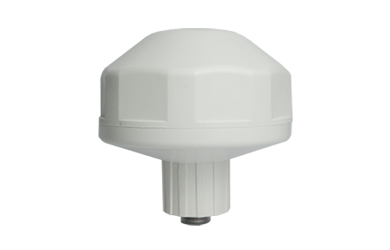
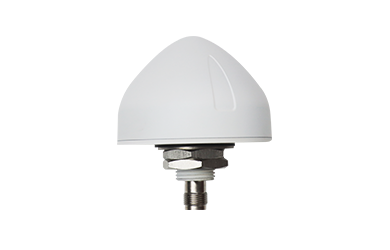
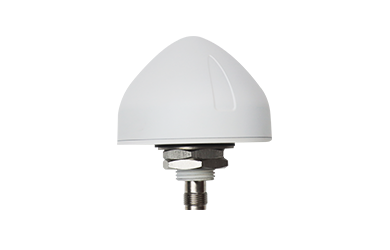
Harxon full-band GNSS timing antenna
1. Match Frequency Bands and GNSS Constellations
The first step is to check the timing receiver. Confirm which GNSS frequency bands and satellite systems it can process before selecting an antenna.
A single-band antenna may be suitable for basic timing systems, local network equipment, or receivers that only support L1. Dual-band antennas are a better fit when the receiver supports multiple frequencies and the application requires improved signal availability or reduced atmospheric error. Full-band antennas are intended for demanding environments where multi-frequency, multi-constellation coverage and future system expansion are important.
| Antenna Type | Suitable Application | Main Advantage | Key Check |
|---|---|---|---|
| Single Band | Basic timing and simple network equipment | Simple and cost-efficient | Receiver band support |
| Dual Band | Telecom, base stations and power systems | Better frequency diversity | Receiver must support both bands |
| Full Band | Critical infrastructure and data centers | Maximum coverage and flexibility | Full signal compatibility |
Do not assume that a full-band antenna will improve performance if the receiver cannot use the additional signals. The antenna and GNSS clock must be specified together.
2. Check GNSS LNA Gain, Noise Figure and Receiver Compatibility
An active GNSS antenna uses an LNA to compensate for signal loss between the antenna and receiver. Too little gain may reduce the signal level after a long cable run. Too much gain may overload the receiver or increase intermodulation in a high-power RF environment.
Check these specifications together:
- LNA gain and tolerance
- Noise figure
- Receiver input range
- DC bias voltage and current
- Impedance
- Connector type
- Active antenna power requirements
An example from Harxon, a GNSS Antenna Manufacturer and GNSS Antenna Supplier, is the HX-TR401A. It specifies 37 ± 3 dB LNA gain, a noise figure of ≤2 dB, a 3.3–12 VDC operating voltage range, and a current requirement of ≤45 mA. These values are useful only when they match the receiver and the complete RF path.
3. Calculate Cable Length and Signal Loss
A rooftop antenna connected to an indoor receiver may require a long coaxial cable. Cable loss increases with both cable length and frequency, so the cable should be selected using its attenuation data rather than its price or availability.
Antenna Gain – Cable Loss – Connector Loss – Surge Protector Loss + Inline Amplifier Gain ≥ Required Receiver Input Level
Also consider splitters, adapters, grounding components, and weatherproof connectors. There is no universal maximum cable length. The correct length depends on antenna gain, cable type, receiver sensitivity, and the amount of signal margin required.
For long installations, use a low-loss cable and confirm that any inline amplifier does not push the receiver beyond its maximum input level.
4. Control RF Interference and Multipath
GNSS signals are weak when they reach the ground. Nearby LTE, 5G, radio, microwave, or broadcasting equipment can overload the antenna’s front end even when the GNSS frequency itself is correct.
For congested RF sites, look for:
- Out-of-band rejection
- Integrated filtering
- LNA overload resistance
- Stable performance near strong transmitters
- Low-elevation gain control
- Good RHCP performance and axial ratio
The antenna should also be installed in an open-sky location, away from metal roofs, HVAC equipment, parapets, and other reflective surfaces. For high-precision timing, ask whether the manufacturer can provide group-delay and phase-center information. These specifications become more important when the timing error budget is tight.
5. Verify Outdoor Installation and Long-Term Reliability
A timing antenna may remain outdoors for years, so mechanical and environmental specifications deserve the same attention as RF performance.
Confirm:
- Mounting method and structural stability
- Connector orientation and cable strain relief
- IP rating
- Operating temperature and humidity
- UV and weather resistance
- Lightning and surge protection
- Grounding and cable-entry arrangement
The antenna enclosure may be waterproof while the connector still requires sealing. Surge protection should be treated as part of the complete installation rather than as a feature of the antenna alone.
Which GNSS Timing Antenna Fits Your Application?
For basic timing and short cable runs, a Single-Band Timing Antenna may provide a practical solution. For 4G/5G base stations, power synchronization, and more demanding outdoor sites, a Dual-Band Timing Antenna usually offers a stronger balance between performance and system complexity.
For core telecom networks, data centers, financial systems, and other mission-critical infrastructure, a Full-Band Timing Antenna, multi-constellation solution provides more signal options and expansion capability. As an OEM GNSS Antenna partner, GNSS Antenna Manufacturer, and GNSS Antenna Supplier, Harxon offers Single Band, Dual Band, and Full Band timing solutions for different system requirements.
Expert Tip: Prepare These Details Before Requesting a Recommendation
Send the antenna supplier:
- Timing receiver make and model
- Supported GNSS constellations and bands
- Receiver bias voltage and current
- Cable type and estimated length
- Antenna and receiver connector types
- Installation location and mounting method
- Nearby RF transmitters or interference sources
This information allows the antenna, cable, amplifier, and protection components to be evaluated as one system.
Common GNSS Timing Antenna Mistakes
- Assuming higher gain is always better.
- Checking frequency but ignoring Receiver Bias.
- Calculating only cable length while ignoring connector and surge-protector loss.
- Assuming a waterproof radome means the connector needs no sealing.
- Treating a receiver lock as proof of timing performance.
- Replacing a timing-grade antenna with a basic positioning antenna.
Conclusion
The best GNSS timing antenna is not simply the one with the highest gain or the widest frequency range. It is the antenna that matches the receiver, preserves signal quality through the entire RF path, controls interference and multipath, and remains stable in its installation environment.
If you are selecting an antenna for a real project, explore Harxon’s Timing Antenna range and share your receiver model, required bands, cable length, connector type, and installation conditions with the Harxon technical team for a suitable recommendation.
FAQs
Is a GNSS timing antenna different from a positioning antenna?
Yes. Timing applications place greater emphasis on signal-path stability, filtering, multipath suppression, group delay, and long-term environmental reliability.
Is a single-band antenna enough for GNSS timing?
It can be suitable for L1-only receivers, basic timing systems, and relatively simple RF environments. More demanding applications may require dual-band or full-band coverage.
Is higher LNA gain always better?
No. Gain must compensate for cable and component losses without exceeding the receiver’s maximum input level.
How long can a GNSS antenna cable be?
There is no fixed answer. Calculate cable attenuation, connector loss, surge-protection loss, antenna gain, and receiver input requirements together.
What information is needed to select a GNSS timing antenna?
Provide the receiver model, supported bands, bias voltage, cable length, connector type, installation environment, and nearby RF interference conditions.